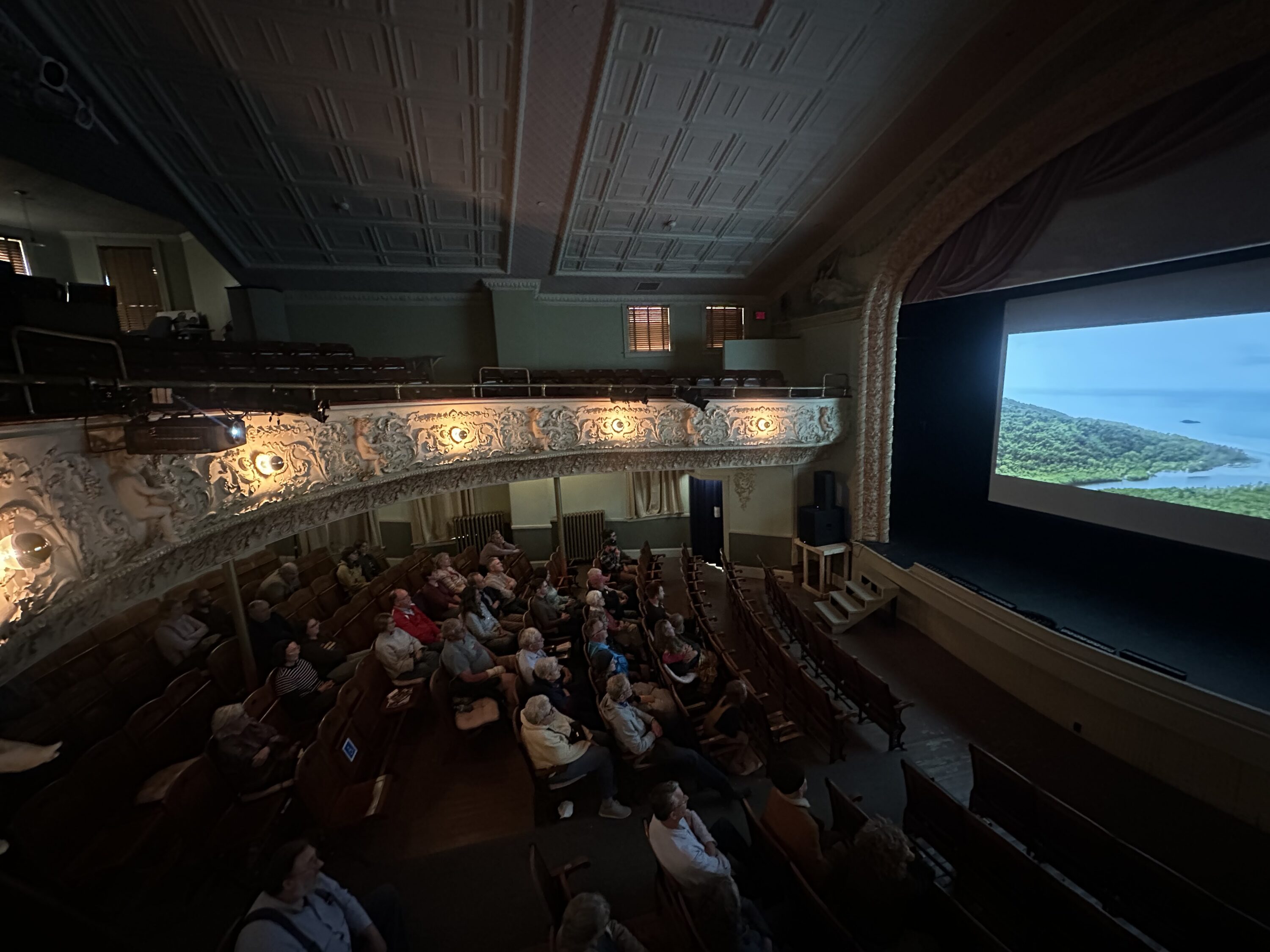
Straddling the Canada–U.S. border, stands the extraordinary Haskell Free Library and Opera House—a building quite literally connecting two nations. This year, as Vermont River Conservancy’s Community Engagement Coordinator, I had the opportunity to organize the celebration of World Fish Migration Day with a film screening of the acclaimed documentary “River” 2021. The Haskell Opera House was the perfect venue for the cinematic experience. Vermont participants joined us from the US entrance, and Quebecois joined us from the entrance on the Canadian side.
This library and opera house began construction in 1901 and was finished in 1904, with the international border not officially established until 1908. Even then, visitors would bounce back and forth, entering from one side of the building and crossing between countries without much thought.
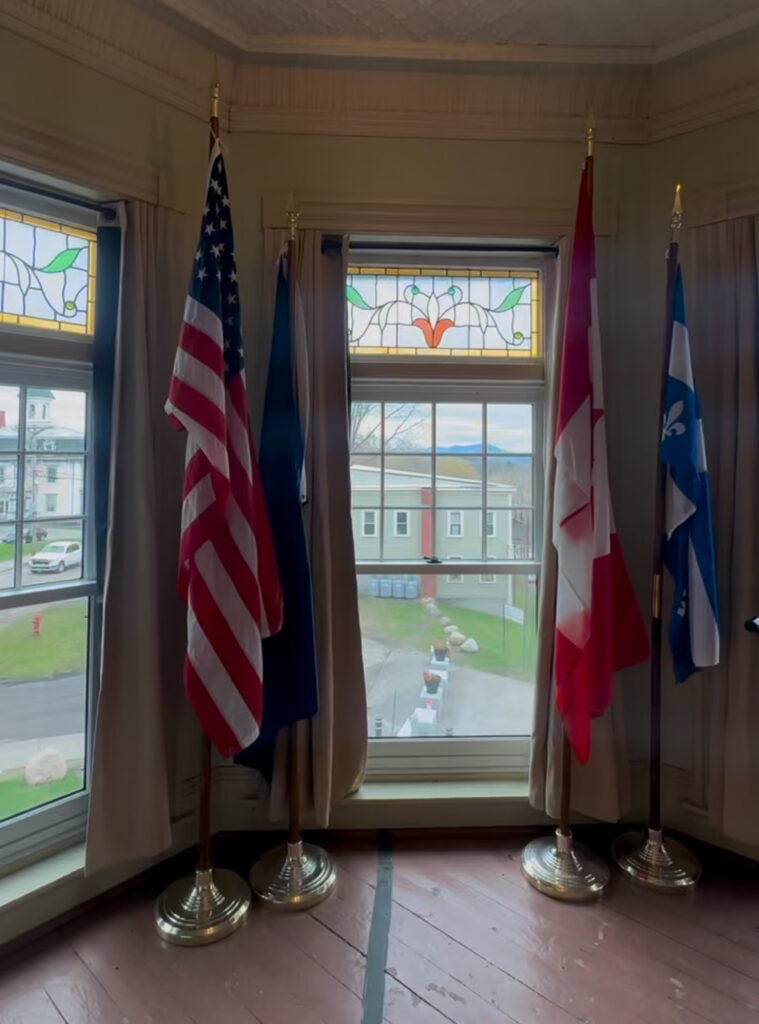
Canada/US Border from the Haskell theater marked with boulders outside.
Now, things have changed.
When I told my dad about celebrating World Fish Migration Day in a building that crosses two countries, he said, “Good idea — fish don’t need passports when they’re migrating.” This led me to reflect on migration itself…
Why do species migrate?
Fish migrate to reach spawning grounds, birds migrate for food and breeding habitat, and seeds disperse along rivers and floodplains to propagate forests further downstream. Entire ecosystems rely on movement and migration. Some species will migrate for education, family, and employment. Entire populations rely on movement and migration.
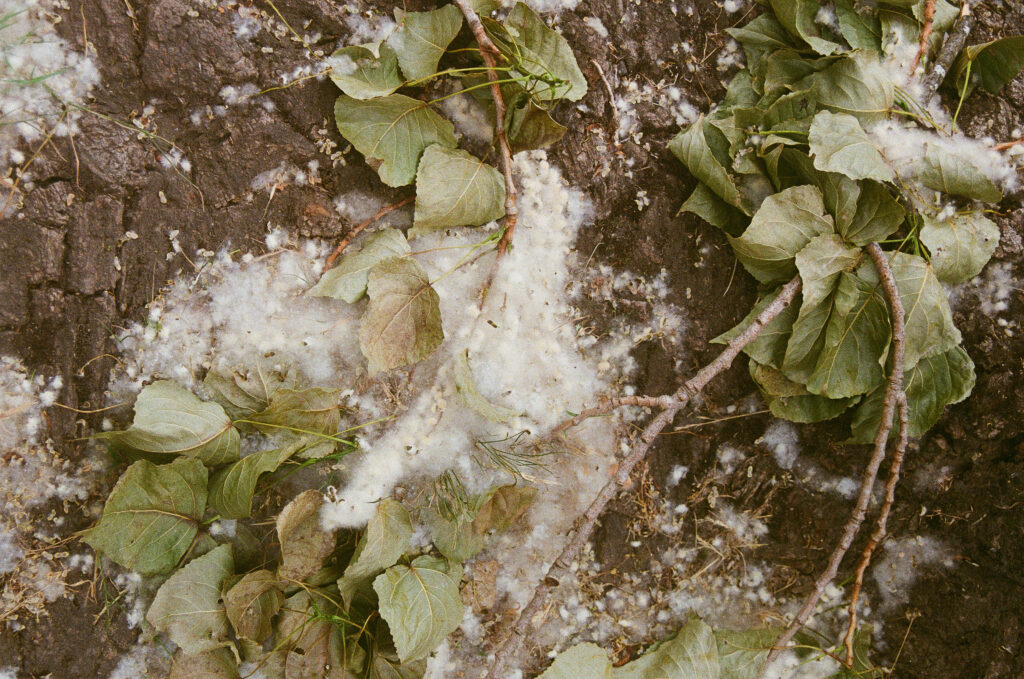
Cottonwood Tree (Populus deltoides) pods wind dispersing seeds photographed by Gabriella Marchesani
But just as these boulders outside mark borders for humans, we too have created barriers for fish. We’ve interrupted natural processes of migration.
Along free-flowing rivers, fish once migrated to their spawning grounds. Along riverbanks, birds migrated. Above the water, seeds dispersed and forests expanded in support of countless species. Humans followed these same waterways too — paddling along meandering rivers and free-flowing currents.
Indigenous peoples understood these natural processes: the meandering of rivers, the flooding of floodplains, the braiding of streams, the migrations of fish and wildlife. When Indigenous people stewarded the land, rivers meandered naturally and provided abundant fish protein and transportation routes. They built lives alongside these rhythms, relying on them for survival. Then things changed globally.
Rivers in the eastern United States have undergone significant transformation over the past three centuries. During the colonial and early industrial periods, rivers became something to control, and not live in harmony with. We channelized them, straightened them, dammed them, used them for waste disposal, and we ignored their natural course.
But rivers still connect us, and they always will.
Every community in Vermont is part of a watershed. Every town has a river flowing through it — but not every community has public access to that river. For 30 years, Vermont River Conservancy has worked to protect and restore rivers for people and wildlife across Vermont.
When we protect free-flowing rivers, we protect the connection between people, communities, wildlife, and generations of cultural practices.
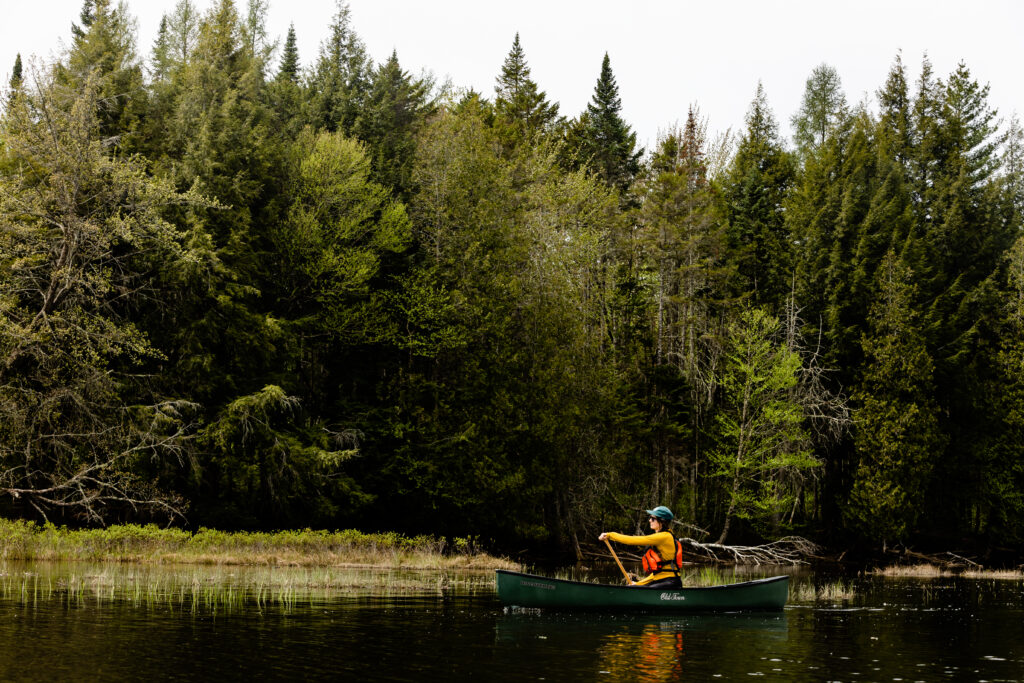
Woman canoeing down the Clyde River on World Fish Migration Day in East Charleston, VT. Photographed by Evan L’Roy
I’ll admit — I’m more of a bird girl myself, and I still have a lot to learn about fish. At first I thought: why a global celebration of migrating fish? What does this really mean for anglers, paddlers, naturalists, and communities? I learned that I have been missing one of Vermont’s premier wildlife watching opportunities—happening underwater and at our waterfalls each spring.
Determined steelhead rainbow trout migrate upstream, leaping and jumping over waterfalls to get to their spawning ground. People come from across the Northeast to witness this incredible migration and to fish these waters.
And then I learned that World Fish Migration Day is about much more than fish, it’s also about rivers supporting life. It’s about people, culture, and livelihood. Humans would not be here today without rivers. Rivers have connected people since the beginning of time. They are the arteries of Vermont and of ecosystems everywhere.
Yet we’ve reshaped, moved, and dammed them to fit our own needs, often without thinking about the life that depends on free-flowing water. When we care about fish migration, we care about water quality, rivers, plants, birds, and entire ecosystems. We begin safeguarding cultures and livelihoods that have depended on the free passage of fish for generations.
And honestly, we don’t even need a human-centered reason to care about fish. Fish and their migration alone matter because it is ancient, complex, resilient — and really cool.
Think about the journey of Atlantic salmon. Maine and Iceland sit more than 2,000 miles apart, connected by the same cold Atlantic waters. Young salmon spend years in the rivers and streams of Maine before transforming for life in the ocean. Some travel as far as Greenland before eventually returning to the very rivers where they began. These migrations connect entire continents.
Standing in this theater, with a line drawn across the floor marking the Canada/US border, I was joined by both Vermonters and Quebecois. The Haskell, just like our waterways, crosses national borders. In this binational celebration of free flowing rivers and migratory fish, we are reminded that neither rivers or migration have border lines.
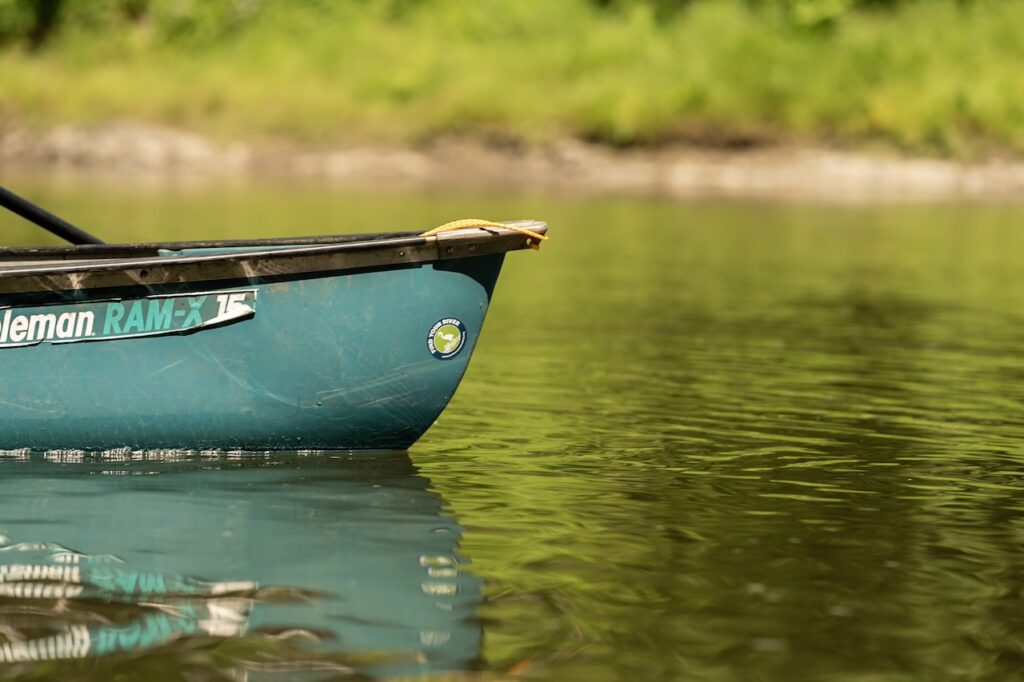
Canoe with a “find your river” sticker photographed by Evan Kay