The Art of Repair: Mending What flows
This July marks three years since the catastrophic 2023 floods in Vermont. Since then, the relationships between impacted communities and their rivers have changed. It is difficult to embrace the flow of rivers when you’re living in a flood zone with no house to move into, or nowhere else to go.
At a time when river restoration is more important than ever, there is also a need to mend relationships with rivers themselves. Many Vermonters are in a constant state of repair, with their homes, communities, and with waterways that are both beautiful and sometimes devastating.
How can we mend our relationship with something capable of both sustaining and destroying us? Artist Renée Greenlee, installation artist and photographer based in Vermont, offers an insight into this mending through her unique art-making.
Science, Art, and Hope:
Renée Greenlee uses analog art processes, which require time and reflection. The slow process of analog development in the age of ubiquitous artificial intelligence invites a slow meaningful process of connection and change.
Her art tackles the science of denial and how we can bridge this gap between the beauty and magical nature of watersheds, along with the very real impacts of flooding. Science of denial often strategically overlooks the realities of anthropogenic climate change–and tools we need to address it. Rather than separating science from emotion and connection, she brings them together through slow observation and artmaking to bridge a path of hope.
Blue Alchemy: Learning from the Watershed
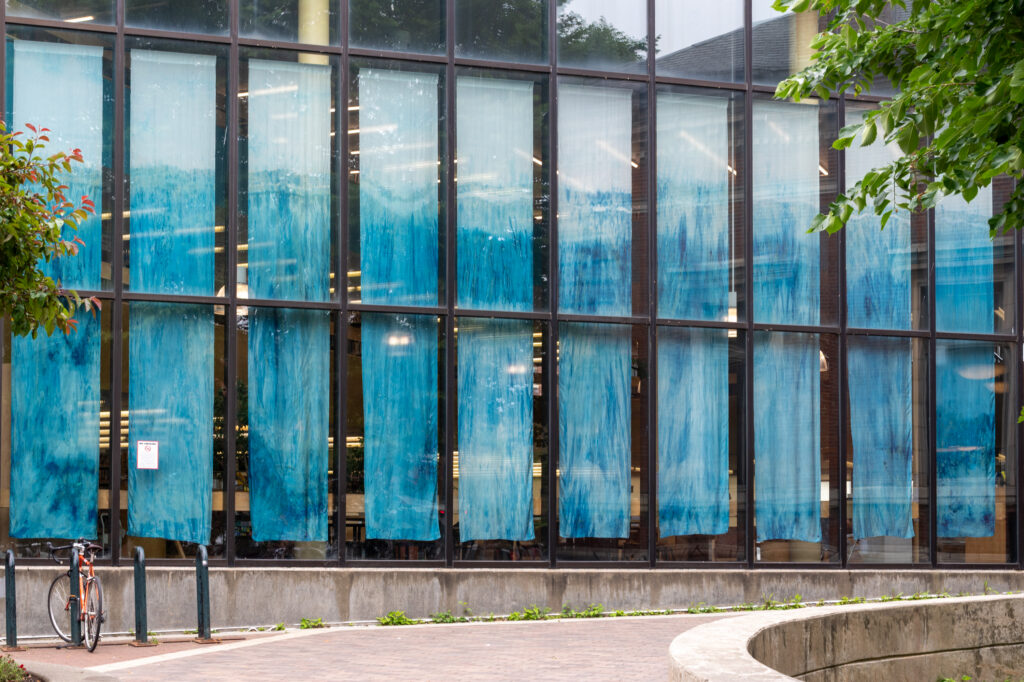
Blue Alchemy, Site Specific Installation Fletcher Free Library, Burlington VT, 2023 PC: Renée Greenlee
Art-making can instill that sense of belonging with the watershed. Water art-making is deeply local, opening a space to slow down, feel, and reflect. It’s more than a deeper understanding of floods in the age of climate change; it restores hope that encourages changemaking. When we slow down enough to observe a river, we begin noticing patterns that data alone can’t teach us.
For over 10 years, using silks and watercolor paper, Greenlee has been cyanotype printing the watershed across the Lake Champlain basin for her “Blue Alchemy” project. A cyanotype is a print created by exposing UV-reactive chemicals to sunlight.
Each silk is treated with cyanotype chemistry, which is then gently placed into the water. The water will bunch over the silk, while not fully submerged, creating a print with the sun. Greenlee repeats this process across the watershed. Each process creates different results depending on the way the rocks, sun, and water current influence the color exposure.
In the water, the chemical reaction of the iron salt trying to stay on the canvas, creates the image of flowing water. When the paper or fabric is in the water, there’s no control of the cyano printing, which varies in different weather conditions–cloudy, rain, sun, and snow. It is a slow process and act of observation where the landscape becomes the number one collaborator. In doing so, we learn the story of the river, from its corridors, floodplains, stream flows, and riparian lands, to our greater impact on its constraints.
Greenlee emphasizes how special this process is for getting to know your locality by dedicating time in your landscape. Through years of printing, she’s created a mapping of the watershed through cyanotypes that is deeply connected to place.
Finding the Beauty of Repair:
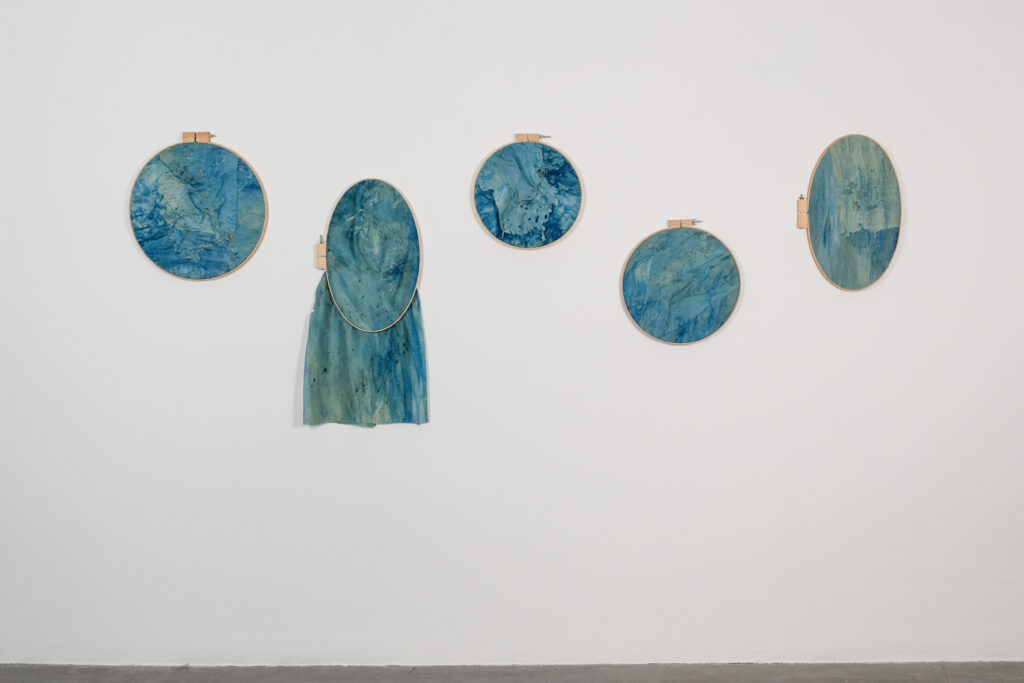
“State of Repair”, 2026 cyanotype on silk, gold embroidery, and wooden/metal hoops shown at BCA Gallery. PC: Liza Voll
Is it possible to restore a reciprocal relationship with the watershed after devastating floods?
Moved by curiosity, Greenlee wanted to learn how these UV-silks would decompose. The end of the silk was wrapped around the base of a maple tree outside her house, and the rest was kept buried for a few months. When the silk was unearthed from underground, the fabric revealed fractal patterns: holes, complementary colors, tears, microbial activity, and soil interaction that followed the movement of the watershed print.
Greenlee could see exactly where the decomposition took place, and decided to find the beauty in its repair. Instead of hiding the holes and tears of the decomposition, Greenlee embroidered them using gold thread, finding a way to repair by mimicking the watershed patterns, tears, and decay. The fabric repaired in gold held together visible traces of change, resisting the science of denial. Again, the fractal patterns of decomposition mirror how humans are both beautiful and destructive. The artwork became a thought experiment and scientific experiment simultaneously. It seems we are in a constant state of repair.
After the Floods:
For Greenlee, these questions are deeply personal. Renée Greenlee lives in Huntington, where people were devastated by the floods. Following the 2024 floods, Greenlee, along with other volunteers, helped start RAFT, a Long Term Recovery Group (LTRG) that serves Huntington, Hinesburg, and Richmond. She opens up about not being a scientist with the answers, but an artist with the shiny, pretty tools to lure our magpie eyes and instigate meaningful conversations that lead to action. “The beauty of an art piece opens a capsule to then absorb information.”
It’s difficult to embrace the flow of waters when you’re stuck in a system that has determined your future, with nowhere to move. Art is a way of focusing for Greenlee, to strengthen ties of community.
She expresses the fear post 2023 floods, “people are going to hear rain, not being quite sure,” viewing water as something destructive. Many Vermont families remain trapped in flood-prone areas, unable to relocate. Living in a floodplain drastically changes one’s relationship with rivers. She thought of ways to make artwork that is productive for building community. So as her cyano fabrics decomposed and the colors revealed complementary yellows to the blues, she sought the beauty of getting things back together.
Ecological grief in the age of climate disasters repeats in cycles of devastation – inevitably changing our relationship to natural processes. How can we mend our fear of floods, while understanding a floodplain’s natural course? How can communities find our golden thread to mend our decayed relationships with the course of the river?
Rivers are always changing, meandering and inundating floodplains. Art won’t stop floods from occurring, but it creates a space for both realities to coexist and change how we relate to them. Repair itself can be beautiful–a chance to embrace resiliency and community. As VRC works to restore river corridors and reconnect rivers, Greenlee’s work reminds us that restoring a watershed includes the relationships that flow alongside it.
Let’s Restore Rivers Together!
These conversations inspire our work at Vermont River Conservancy. This fall, VRC is hosting a series of river tours across Vermont. Interested in learning from the landscape through slow art-making?
Art is meant to be shared, creating connections between people and place. Come join us!