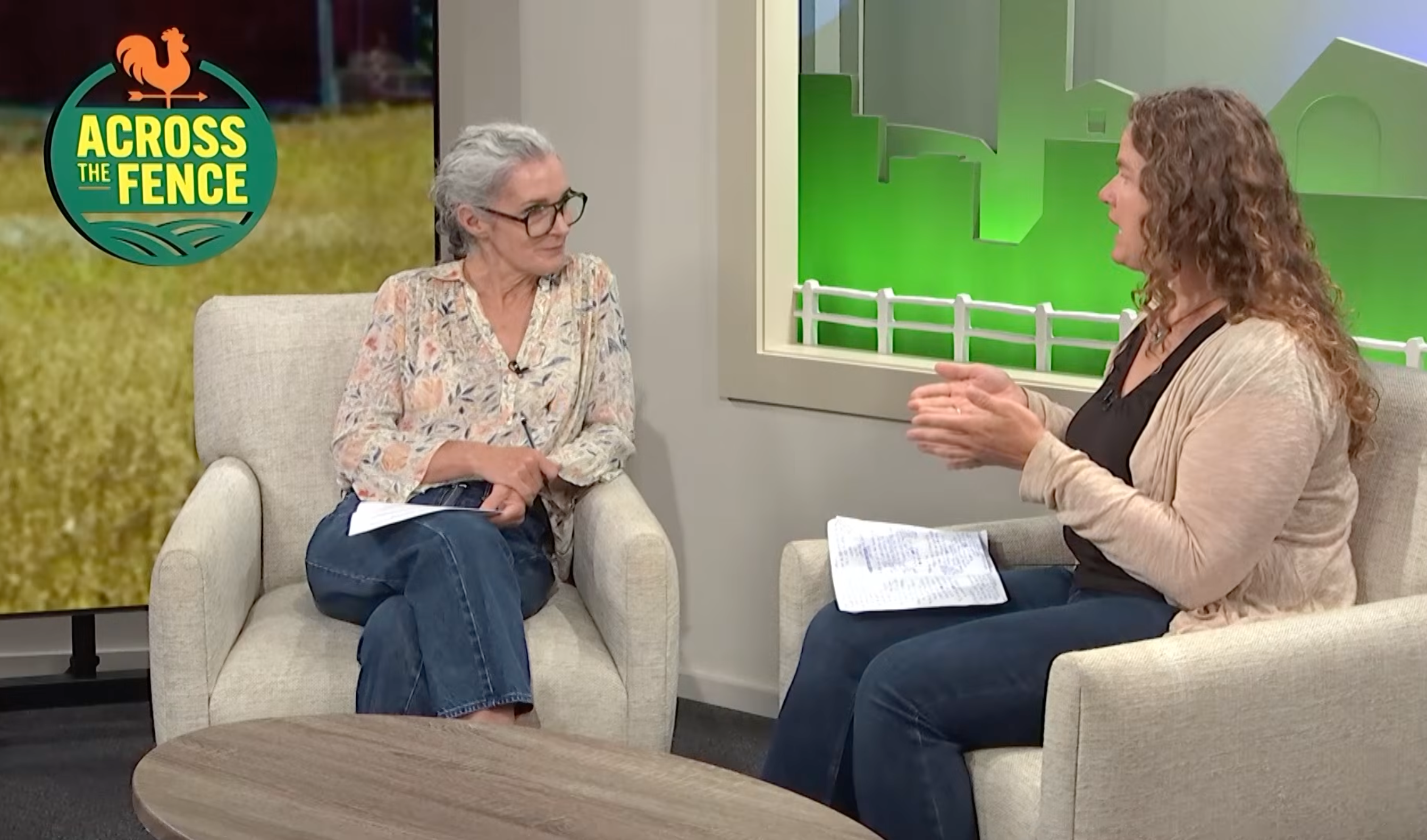
On August 14, Kassia Randzio, Executive Director of the Vermont River Conservancy (VRC), joined WCAX’s Across the Fence for a special conversation about protecting Vermont’s rivers.
Thanks to the support and engagement from our social media followers, VRC gained the momentum that led to this exciting invitation to appear on Across the Fence. This opportunity wouldn’t have been possible without our dedicated volunteers, followers, river lovers, donors, and everyone who continues to support our mission.
In the conversation, Randzio discussed VRC’s 30-year mission to protect public access to rivers while preserving the natural systems that support Vermont communities. She also went over the importance of swimming-hole safety, particularly as climate change increases the risks associated with rain events, changing river conditions, and flooding. Increased precipitation, rain-on-snow events, drought, and flooding are affecting rivers and communities across the state. Randzio highlighted how conservation can help Vermont work with its rivers rather than against them.
She encouraged Vermonters to get involved by learning about their local rivers, volunteering with conservation efforts, and donating to support the conservancy’s work.
Watch the full video and/or check out the transcribed interview below!
Protecting Vermont’s Rivers: Interview Transcript
Amy Finley:
Joining me today is Kassia Randzio, the executive director of the Vermont River Conservancy, which launched 30 years ago when a group of volunteers came together to protect access to a swimming hole on the Dog River. Kassia Randzio, welcome.
Kassia Randzio:
Thanks for having me. It’s lovely to be here.
Amy Finley:
Let’s start with swimming holes. One, because I was just at one, but also that’s kind of where the conservancy began. So talk to us a little bit about what you’ve been doing now.
Kassia Randzio:
Yeah, so our work really began in the mid-1990s, and I think for so many Vermonters, swimming holes are just part of a quintessential Vermont summer experience. It’s right up there with creemees in terms of what it means to have summer in Vermont. We can combine the two. That’s a perfect day.
In the mid-’90s, land started to transfer and change hands a little bit more frequently, and so there were communities across Vermont where, you know, there’s not a swimming pool in every little rural town, but what you have is almost every town, every community has a swimming hole.
As land was changing hands, people were putting up “No Trespassing” signs, and communities were coming together and saying, “That’s not okay. That’s our place. That feels like a public place.”
Amy Finley:
It’s like a public beach.
Kassia Randzio:
These are places where kids spend entire summers. They attract generations, so it’s grandma and grandpa and the kids and everybody in between, out with a picnic. And there was this fear that we were going to lose access as a state and as communities to this really public asset.
So our organization came together to help protect these places by buying the land, doing conservation easements, and making sure that people would always have this amazing experience.
Amy Finley:
Yeah, and even a little bit beyond swimming holes, right? Because it’s fishing access, and it’s places where you can put a boat into the water, like your kayak or something like that, too.
One of the things I know that you do on your very phenomenal website, which people should definitely spend some time on, is you’ve got this great little section, “Find Your River.” So you’re helping people connect to their next adventure, too.
Kassia Randzio:
That’s right. And so, over the last 30 years, our work has not just been swimming holes in terms of recreation, but places to cast a line, places to launch a canoe, a kayak, and now more and more, of course, stand-up paddleboards.
On our website, there’s a spot at the top called “Find Your River.” You click on that, and you can go to an interactive map where you can filter by your favorite activity. You can check out different places, and it’s a wonderful way to find a place you haven’t been to before and maybe add someplace new to your summer bucket list.
Amy Finley:
Yeah, make your summer even better.
Kassia Randzio:
That’s right.
Amy Finley:
Well, one of the ways that I, in part, got you on my radar was because you have a phenomenal Instagram account also, which does a lot of posting about things like swimming holes, but not just swimming holes, also things like how to be safe at swimming holes and rivers.
And, you know, this summer we’ve had a few tragedies. So what are some tips that people need to know about also being safe around swimming holes?
Kassia Randzio:
I’m really glad you asked that question because that’s so important. We go to these places to have fun, and a fun day needs to be a safe day, too.
And so that really starts before you even get to the swimming hole. So there are the things that may be obvious, like packing your sunscreen and hats. We recommend closed-toed shoes because there are rocks and sticks, just to protect your feet for whatever’s out there.
And then life jackets. I know people think of life jackets as something you would bring on a boat. Swimming holes are also an amazing place for a life jacket. They help kids float. I prefer to swim in a life jacket because it’s cozy, and you never know when conditions are going to change, and they keep kids safe out there.
Amy Finley:
Swimming holes can be a little unpredictable.
Kassia Randzio:
Exactly. And what’s happening more and more with climate change is that there are more small storms that may not even be where you are, so you may not feel a drop of rain where you are. But up the mountain, up above you, there’s been a small thunderstorm, and that water comes right down, and it can really change the currents really quickly.
And so, if you’re out with kids, making sure you have what we call a “water watcher,” which is somebody who’s 16 years or older, prepared to help out and actively watching kids.
That’s the tricky part. I’m a mom. It’s very tempting to just sit and read your book and have a nice time. But the act of watching is really important because, unlike a pool where there might be lifeguards, there are no lifeguards out in nature, and we just never know when conditions are going to change.
Amy Finley:
Well, and let’s stay there, too, because you were talking about climate change and the impact of climate change on rivers, and that gets into the wider mission of the conservancy. Absolutely.
So let’s take that 20,000-foot perspective and talk about what is happening with rivers in Vermont and what we’re seeing. What are the impacts of climate change on our river systems?
Kassia Randzio:
Yeah. So the way that climate change is really felt in Vermont comes back to our rivers in so many ways. We’re seeing more precipitation. We’re seeing more rain on snow in the winter. We’re seeing more drought.
All three of those things mean more flooding, and so that’s really felt by our rivers and absorbed by our rivers and felt by our communities.
As we’ve seen each of the last several years, what it means is friends and neighbors, whole communities with schools shut down, roads closed, water in kitchens—all of those really traumatic impacts.
Yet we know, like where we started, rivers are also an asset in our communities. So it’s a tricky balance there.
Amy Finley:
Yeah, and many of our communities are actually integrated, kind of, in proximity to rivers.
Kassia Randzio:
Absolutely.
Amy Finley:
Just think about the traditional way of getting around, transportation. Even our villages grew up around these rivers.
So what does conservation work look like for helping protect rivers? And, like, do we even know what a river looks like anymore? In California, all of our rivers are essentially running through concrete channels. What is a river intended to be like, and how does that go along with the River Conservancy’s work?
Kassia Randzio:
Yeah, that’s a great question.
We think of our rivers as being really natural. They have trees along them. The reality is that 75% of the length of our rivers have been altered over time.
And that has a lot to do with our land history. In the late 1800s and early 1900s, all of Vermont was essentially clear-cut. When that happened, there were roads, railroads, and we were moving logs, and so we were literally dynamiting stretches of rivers.
When settlers came, one of the easiest places to build is right along the floodplain. A floodplain is part of the river. It’s intended for overflow. And for millennia, our rivers have overflowed across the land.
When we’ve built up in those places, we’ve literally been building in the riverbed. And so, once one flood happens, the kind of reaction is to build up the riverbank, and it straightens the rivers. It makes everything faster and really more harmful because the rivers are more powerful.
Amy Finley:
So talk to me about these easements that you are doing with farmers and what that does in the landscape.
Kassia Randzio:
As a land trust, the bulk of our work is protecting land through conservation easements, and a lot of those easements are with farmers.
We hold over 100 easements across the state, and oftentimes we can see this during floods—and I know farmers feel it—that when floods happen, oftentimes farms are the first to flood because it’s the open land.
And farms are there because of the floods. The soil is rich; it’s rich because of the floods for eons.
And now, when the land is flooding, it of course ruins crops. Those types of impacts to farmers—
What we do is work with farmers and compensate farmers up front and say, “You know what? Keep owning your land. Keep farming your land. This is really important. But you’re going to allow 50 feet or more of the land between your crops and the river to grow up as trees, as shrubs, and have that natural buffer between the farm and the river.”
And what that does is the roots hold the soil in place. So for farmers, it’s actually really great for preventing erosion.
And when the next flood comes, it acts as a sieve, and farmers agree there to allow the water to flow over the land and do all of us this community service and benefit, which is why they’re compensated.
Amy Finley:
I love that the conservancy has this sort of macro-to-micro view of community and how community interacts with water, because it’s all the way from that larger-picture perspective of how rivers are flowing through our landscape and how do we work with our large agricultural communities and keep our agricultural identity, but then all the way also down to the personal use and how it gets into communities when you can all rally around a swimming hole, too, and keep that relationship.
So this is important work. How can people help?
Kassia Randzio:
Yeah. So I think one of the most important things, first and foremost, is pay attention.
Find a river in your community and follow that river. Figure out where the water comes from. Figure out where that water goes. What’s happening along that river? And just get to know your local river.
And when you do that, you’re going to be paying attention to your place and the broader rivers in a really different way. And anybody can do that, right where they are.
Yeah. Number two is to volunteer and get involved. And so, if you go to our website, there’s a link right at the top that says “Volunteer,” and we have opportunities each spring. We plant over 1,000 trees along our rivers. We’re out helping to build trails along rivers.
So there are a lot of ways to get involved, and not only with us, but a lot of the different watersheds all over the state have a local watershed group, and that is a really wonderful community to be part of.
And then, third, I would say is to donate.
I know that people get asked to donate all the time, and people can think, “What difference would it make if I give $10 or $50?” But even just knowing our listenership and your viewers right now, if one in 10 people were to give $10 a month, we could actually do twice as much work every year.
Amy Finley:
That’s the difference of $10.
Kassia Randzio:
That’s the difference of $10.
Amy Finley:
So you have a lot you can do here. So if you want to know more about the Vermont River Conservancy and its mission to protect floodplains, wetlands, and forests, restore resilient communities, and connect people to rivers, check out their website.