Part 1: Meet the Sea Lamprey
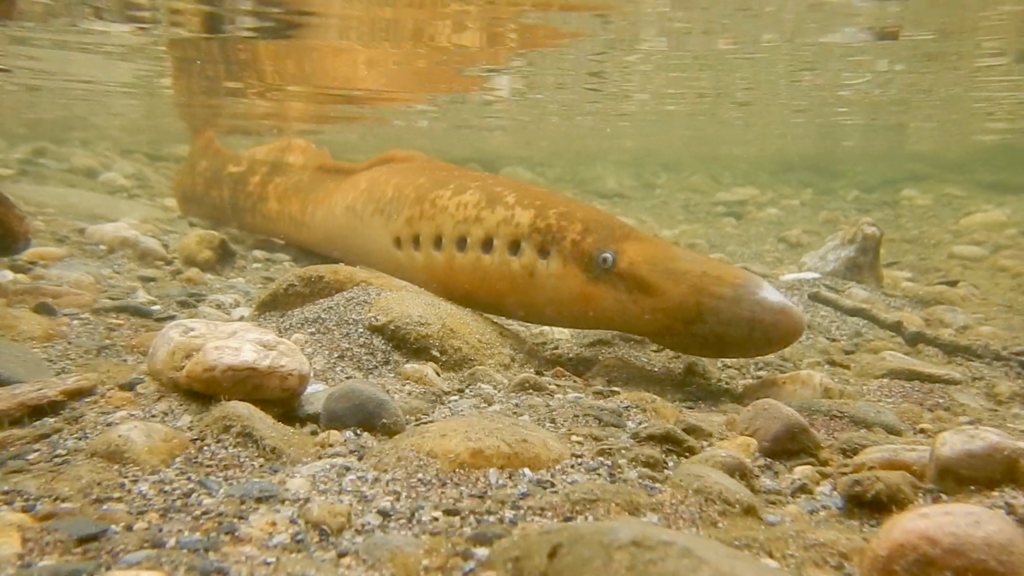
Sea lamprey in the Saxtons River. PC: Jill DeVitto.
Okay, so what’s the deal with these prehistoric orange dinosaurs?
First off, sea lampreys are even older than dinosaurs. In fact, they’ve been around before trees appeared on Earth. Why do they get so much hate in the Lake Champlain Basin? Why are they so important in the Connecticut River watershed?
Sea lamprey are often misunderstood. In this post, we hope to spread the word about lampreys’ role as vital ecosystem engineers, and maybe even drum up some of the appreciation they deserve!
The Story of the Lamprey
Lampreys (Petromyzontiformes) are one of the oldest surviving vertebrate lineages on Earth.
These living fossils have been around for over 400 million years, surviving several mass extinction events and outliving the dinosaurs! To put this into perspective, humans have been around for 300,000 years, meaning lampreys have existed 1,300 times longer on this planet.
You can tell they’re prehistoric just by looking at them.They are jawless parasitic fish with skeletons made of cartilage that breathe through seven pairs of tiny gill openings found behind their mouth and eyes. There are approximately 50 species of lampreys on every continent except Africa. Vermont’s Connecticut River Basin is home to the sea lamprey (Petromyzon marinus).
Sea lampreys have co-evolved with the ecosystems of the Connecticut River and the Atlantic Ocean. Just like salmon, they are anadromous, meaning they begin their life cycle in the river, spend adulthood in the ocean, and return to the river to spawn.
As cool as it is that sea lampreys are ancient survivors of the Connecticut River, there is so much more to their story. These prehistoric fish are also ecosystem engineers, playing an important role in supporting life throughout the watershed. Their final journey upstream is a wild and remarkable one—stay tuned for Part 2: The Final Journey of the Sea Lamprey.