“When times are easy and there’s plenty to go around, individual species can go it alone. But when conditions are harsh and life is tenuous, it takes a team sworn to reciprocity to keep life going forward. In a world of scarcity, interconnection and mutual aid become critical for survival. So say the lichens.” Robin Wall Kimmerer
Whether I am hiking through the Middlebury TAM or my backyard woods in Georgia, I always notice white-ish-green textured splotches on the base and branches of the trees. I am eager to graze my hand on the surface, as the fragile paper-like fibers fall to the ground.
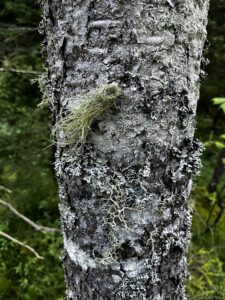
Fruticose lichens on a red spruce at Old Oaks Headwaters Preserve
These are Lichens, a fungi necessary for sustaining the forest’s air quality, cycling nutrients, and feeding other animals such as caribou (and reindeer!). Lichens cover approximately 7% of the earth’s surface and can grow on rocks and other impervious surfaces, on living trees, on decaying wood, and on the forest floor.
Lichens have many growth forms, which result in different shapes and textures. First, Crustose lichens can be, yup, crusty and attach to smooth surfaces like rocks. Next, Foliose lichens are leafy and can look like a cabbage growing on a tree. Lastly, Fructitose lichens are bushy and sometimes a little “hair-like”. These three lichen morphologies are easy to spot on your next hike:

Types of Lichen
But what is their relationship with our rivers? How is their relationship with the river reciprocal in nature?
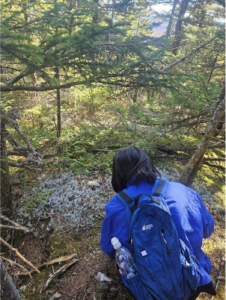
Lichens are excellent indicators of air quality. They absorb nutrients from the air. Certain lichens contain cyanobacteria, which “fix” atmospheric nitrogen into usable forms, enriching the soil with necessary nutrients and supporting the entire food web (native plants, insects, and fungi) that feeds into the river. Assessing the abundance of the three lichen types can reveal air quality, as each type responds differently to pollutants and has varying sensitivities. Lots of fruticose or foliose lichens can indicate clean air, while only crustose lichens may indicate more pollution, with yellow lichens often signaling excess nitrogen. A diversity of lichen types indicates healthy air quality, while an absence of them may be a concerning sign.
Lichens can help reduce erosion: By absorbing and holding water and nutrients from rain, fog, and air, lichens slowly release moisture. This water retention allows for moderate humidity during drought conditions and supports plant life near waterways, supporting riparian buffers. It is fascinating how they operate—when lichens sense humidity, they start photosynthesizing and growing. When lichens are dry, they “turn off”, become brittle, and go dormant. This process is known as poikilohydry, and mosses and liverworts operate in the same way during rainy conditions. Additionally, lichens can work with cyanobacteria and mosses to form biological soil crusts (biocrusts) that physically bind loose soil particles, preventing them from being blown away by extreme wind or washed away by water. Because of their rough texture and attachment to impervious surfaces, the biocrusts serve as a buffer, slowing down the river’s flow speed.
Lichens are resilient, allowing other plants to survive extreme cold and drought. They can create ‘micro-habitats’, tiny niches on rocks and trees that support small plants, invertebrates, and birds, adding biodiversity to riparian zones. In Vermont, Reindeer lichen is a crucial food for moose and caribou, especially during the winter. Hummingbirds also use lichens to disguise their nests, while squirrels and chipmunks hide food in bark crevices covered by lichens. Other birds, such as the white-throated sparrows and juncos, thrive in lichen-rich boreal habitats.
The generosity of the lichens is evident in how much these delicate yet essential organisms contribute to our forest and river ecosystems. We can play a role in this reciprocal relationship by learning more about how lichens function and paying close attention the next time we go outside. Maybe there is a forest in your backyard that has a robust lichen network—what do you see? Are there traces of other thriving plants and river streams around the lichens? The power of lichens is just one key example of how ecosystems can be more resilient when we expand our conservation reach. We can learn from the reciprocity of these organisms and contribute our efforts towards protecting their forest and river ecosystems.